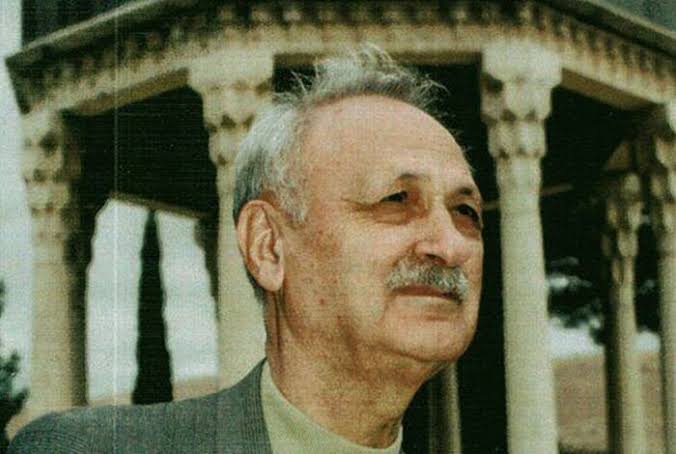
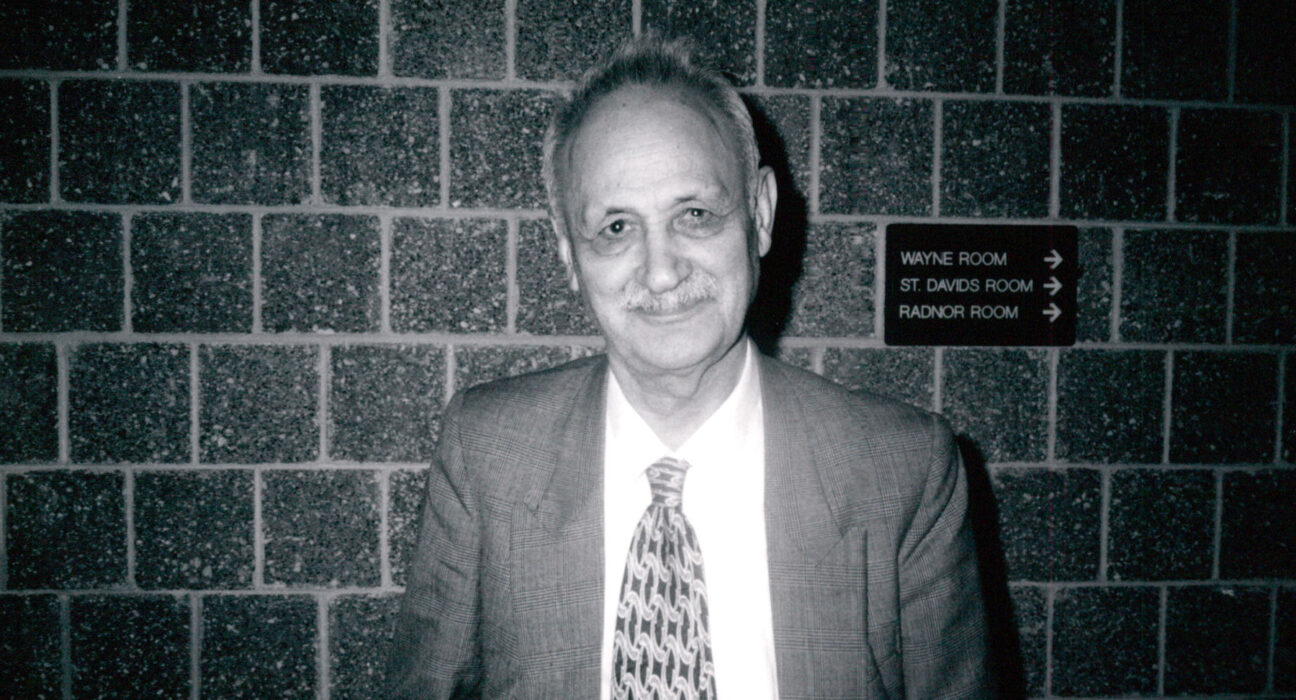
Abdul Hussein Sarreenqub (29 Isfan, 1844 – 24 Shahriwar, 1378) was a renowned contemporary Iranian literary figure, historian, literary critic, writer, and translator. His works are known as important references in the study of Mawlawism and Sufism. He was one of Iran’s most prominent historians and produced acclaimed works on Iranian history as well as the history of Islam. These works are among the best-selling in Iran due to their literary and epic historical expression.
Sarrin Kub has taught Persian literature, Islamic history, and Iranian history at Tehran University for over four decades. Following the revolution, he has worked with the Islamic Encyclopedia, for example, donating 6,500 books and magazines to the institution.
Abdul Hussein Sarrinqub was born on the 29th of Isfan, 1301, in Burujer. His family was originally of the Khunthari clan. His ancestor, Mullah Ali Akbar Khunthari Isfahani, studied at the Isfahan school and was one of the students of Muhammad Baqir Shafti. He completed his basic education in his hometown. He continued his secondary education up to the fifth year at a secondary school in Burujer. After completing the sixth year at the same secondary school, he continued his studies in Tehran. He chose literature and graduated from high school in 1319. The following year, he returned to Burujer and began teaching at the Khoramabod and Burujer secondary schools. During that time, he taught a variety of subjects ranging from history, geography, Persian literature to Arabic literature, philosophy, and foreign languages. Around the same time, his first book, “Philosophy of Poetry” or “A History of the Development of Poetry and Poetry in Iran,” was published. Which was published in Buruñer.
In 1324, after being ranked first in the entrance examinations for the “Faculty of Reasonable and Transmissible Sciences” and the “Faculty of Literature,” he enrolled in the Persian Literature program at Tehran University. In 1327, he graduated with a Bachelor’s degree in Persian Literature with first rank, and the following year he entered the doctoral program in literature at Tehran University. In 1334, he successfully defended his doctoral dissertation, entitled “History and Principles of Poetry Analysis,” written under the supervision of Badiul Zaman Forozanfar. In 1330, Sassarin Qub was invited to participate in a translation project of articles in the Islamic Encyclopedia, along with prominent figures of the time such as Muhammad Mu’een, Parvez Natal Khanleri, Ghulam Hussein Sadiqi, and Abbas Sarjab Khouy.
He began his career at Tehran University as an associate professor in 1335, teaching Islamic history, the history of various religions, theological history, and the history of Sustainability in the Faculty of Literature and Theology. Sarrinqub also taught at Tehran University and the College of Dramatic Arts. From 1341 onwards, he taught at Tehran University, Oxford, the Sorbonne, universities in India and Pakistan, and from 1347 to 1349 he taught in America as a visiting professor at the University of California and Princeton University.
Sarrinqub met Kamar Oryon during their years at college. Kamar Oryon, in an interview with the newspaper Jamul Jam in 1383, explained that they had known each other for almost nine years, until Abdul Hussein Sarrinqub, at the age of 30, proposed marriage to Oryon. According to her, after consulting her father, who knew Sarrinqub well and had read his articles, he thought the authors must have been men around 50 years old. Oryon and Sarrinqub married in 1332 and continued their studies to obtain doctorates (Sarrinqub was the first, and Oryon the second, to pass the doctoral examinations). After completing their studies… The journey began. Sareen Kub and Kamar Auryan lived with their wives in India, Europe, the Arab world, and Lebanon. Sareen Kub and Kamar Auryan had no children. Abdul Hussein Sareen Kub died in Tehran on the 24th Shahriwar 1378 at the age of 76.